Baltimore’s Crime Drop
If you are reading this, no doubt you already know Baltimore has seen an amazing reduction in violence. This started in 2022 and continues into September 2026. There were 333 murders in 2022 and 133 last year. There have been 75 murders year-to-date in 2026 (As of Sep 8).
Why? Well, some combination of everything: police, prosecution, and social and community programs. And perhaps, more importantly collaboration between all these agencies, ideally led by the mayor. I mention this because when they can’t say “root causes,” I’ve heard the usual anti-policing crowd say the crime reduction in Baltimore is all how the mayor has talks about “community-based” approaches to violence reduction. And he does. And maybe this is the reason. And I suspect it has helped. Why wouldn’t it? But there’s no empirical proof. And it would be nice to have some hard data.
We also know an incompetent (and indicted) prosecutor was replaced with an effective one. This matters probably a lot more than people give it credit for. But also hard to measure. Still, you lock up 10 shooters extra, and you might get a dozen or two fewer murders. It matters.
Here’s the thing about policing. We do have hard data. Much of it is flawed, but at least there is a lot of it (that’s a riff on an old joke, by the way). Take arrest data. Not so useful by itself, and arrests are never something that should be the end goal. But it’s still relevant. And the number of arrests can serve as a proxy for police going out and actually (what’s the word?) policing. And changes in this police activity can be quantified over time. Take the summer months of the past 5 years.
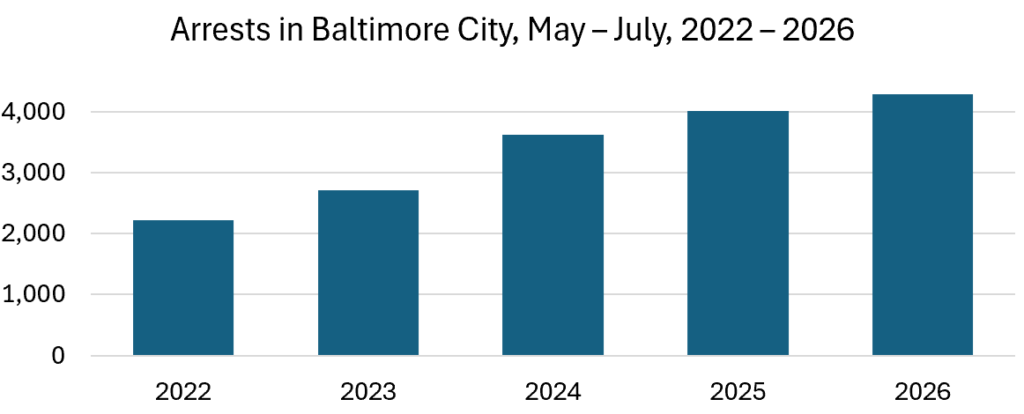
Arrests have doubled since 2022. Wow. If you think that is bad or it totally unrelated to a massive 68% reduction in murder. If so, I think you are (and how can I put this politely?) wrong. Let’s overlay murders during these months. (I’d love to include August, but Baltimore Open Data only goes to August 9 this year [as of Sep 8, 2026]. So it’s May through July.)
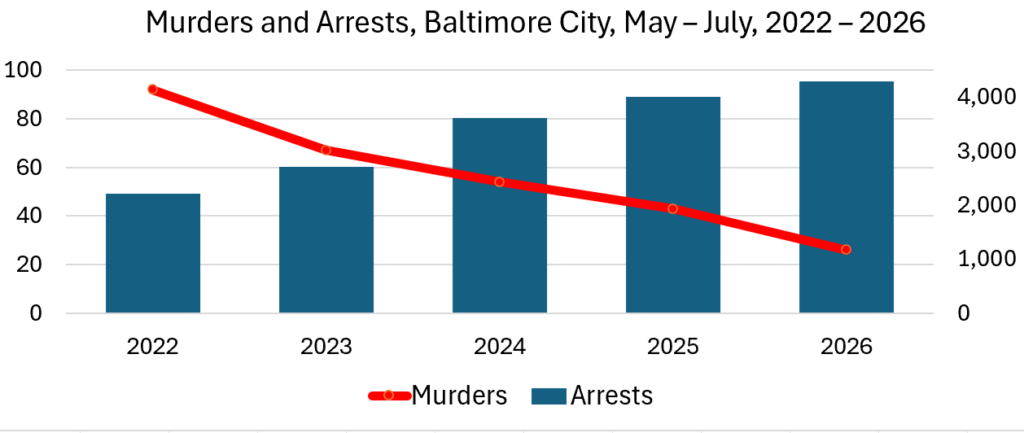
Now, if, on cue, you say “correlation doesn’t equal equation,” forgive me while I slap your sorry ass. Because I friggin’ know that. And the flip side is important: correlation doesn’t indicate lack of causation. Correlation is, as I do like to say, a clue! Or at least something to be explained away. I mean, the link between more policing and less crime is a pretty good clue. Especially because we see it time and time again, city after city, year after year. I’m willing to say it’s more important than whatever good things the mayor says.
But there’s a caveat to all this. This once mattered more than it does in 2026. But some people like to take the above and squeeze it till there’s no more juice. “If a few more arrests are good,” they think, “then a lot more arrests must be even better!” But it doesn’t work that way.
Let’s look at arrests going back to 2010. Arrests have been in a long-term decline. Not just since 2010 but since 2003. And during that time violence has both gone down and up.
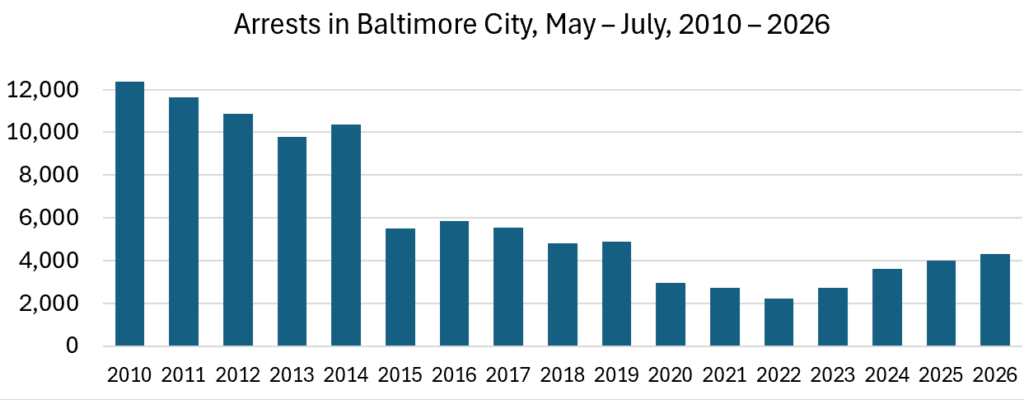
Murders were about 200 annually in 2011 and 2014. (Two hundred murders is a low number for Baltimore; this year there will be closer to 100!) Then in 2015 an “uprising” (AKA: riots) caused policing to decrease quite drastically, and the murder rate after the riot doubled. It was what much of the rest of the country saw in 2020 and I would posit for many of the same reasons. (Worth noting that murders in Baltimore in 2020 actually declined slightly. And yeah, Baltimore had Covid, too.)
But back to arrests, the lesson from the long-term picture is we can and have drastically reduced the number of arrests while at the same time seeing record-low violence. Other things being equal, or better, it is better to have 4,000 arrests in a summer with decreasing violence than 12,000 arrests. That said, 2,000 arrests in summer 2022? I think we can say, confidently in hindsight, wasn’t enough to prevent hundreds more people being shot, and many of those killed.
How can we do more with less? Because the city is better focused on repeat violent offenders. Because when agencies work together, there are a lot more tools in the shed. And when there are fewer arrests and less violence, it’s easier to build on that success. Fewer disrupted lives and less retaliation.
It’s hard work. It’s not rocket science. And more and better policing (along with a lot of other things) is always a necessary (albeit not sufficient) part of the crime reduction strategy.